Introduction
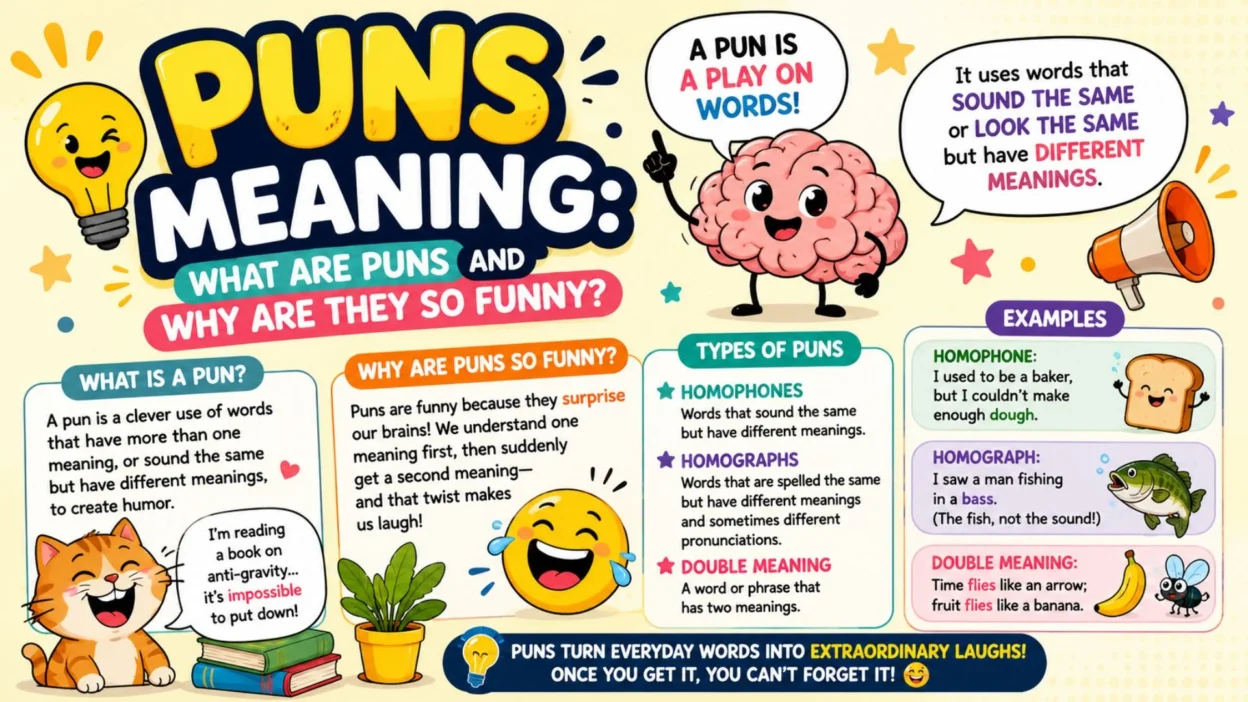
If you’ve ever laughed at a joke that played with the meaning or sound of words, you’ve already enjoyed a pun. Understanding puns meaning is simple once you recognize that a pun is a clever form of wordplay. It creates humor by using words with multiple meanings or words that sound alike but mean different things. From casual conversations to movies, social media captions, greeting cards, and even advertising, puns appear almost everywhere. ✨
People love puns because they make language more creative and memorable. A well-timed pun can lighten the mood, break the ice, or make someone smile in just a few words. Some are witty enough to make you laugh out loud, while others earn nothing more than a playful eye roll—and that’s part of their charm. In this guide, you’ll learn what puns mean, how they work, why they’re popular, and discover plenty of examples that make this unique style of humor easy to understand.
What Is the Meaning of a Pun? 🤔
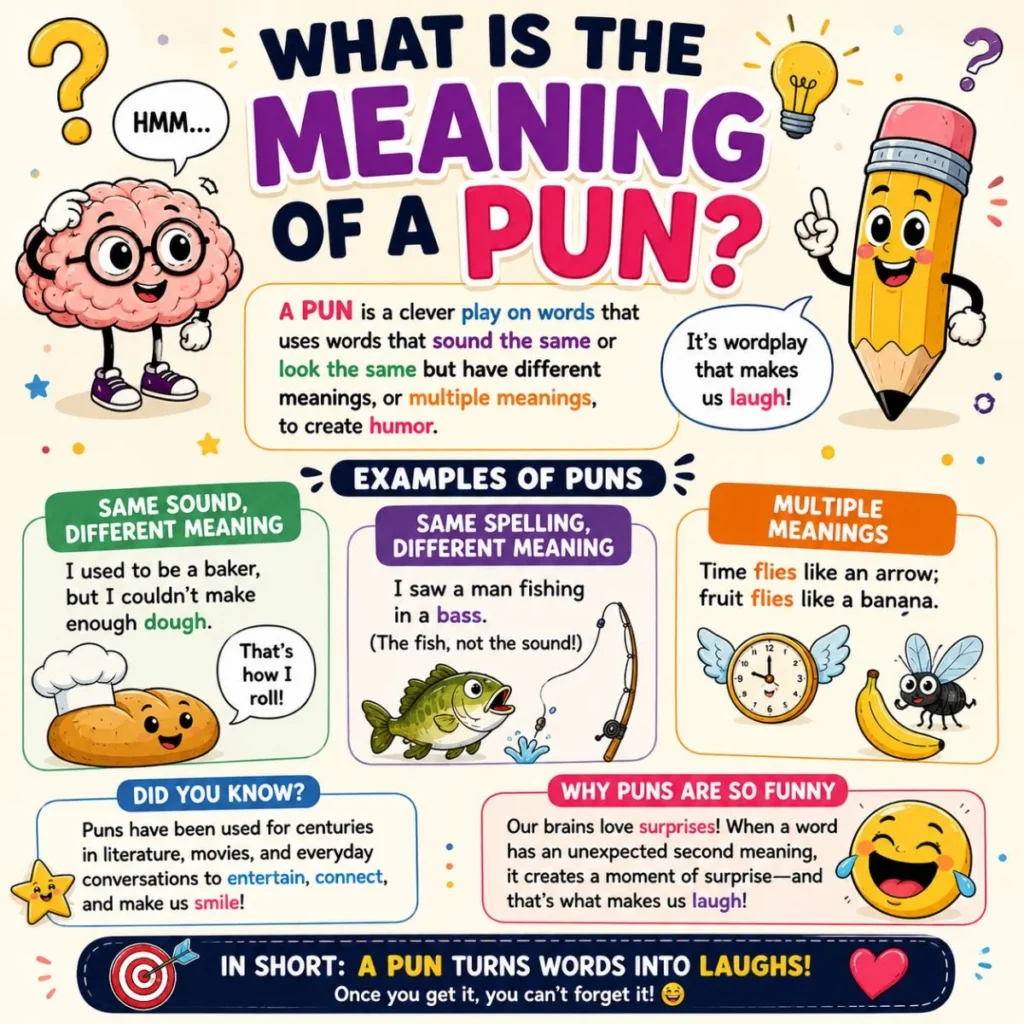
A pun is a joke or humorous expression that relies on words with similar sounds, identical spellings, or multiple meanings. Instead of saying something directly, a pun twists language to create an unexpected and amusing result.
This style of humor has been around for centuries and continues to thrive because it rewards clever thinking. Once you understand the double meaning behind the words, the joke suddenly “clicks,” making it satisfying as well as funny. 😄
- “I’m reading a book about anti-gravity. It’s impossible to put down.”
- “The bakery burned down because the business was on a roll. 🥖”
- “I used to be a banker, but I lost interest.”
- “Time flies like an arrow. Fruit flies like a banana. 🍌”
- “I wondered why the baseball kept getting bigger. Then it hit me.”
- “I stayed up all night wondering where the sun went. Then it dawned on me.”
- “The calendar’s days are numbered.”
- “I couldn’t remember how to throw a boomerang—but it came back to me.”
How Do Puns Work? 🧠
Puns work by surprising the reader or listener with an unexpected meaning. Your brain initially interprets a word one way before realizing another interpretation makes the sentence funny.
That’s why puns often feel clever rather than simply silly. They encourage people to think for a moment before the humor lands, making them enjoyable for both children and adults.
- “A bicycle can’t stand on its own because it’s two-tired. 🚲”
- “The scarecrow got promoted because he was outstanding in his field.”
- “I know a lot of jokes about construction, but I’m still working on them.”
- “The computer caught a cold because it left its Windows open.”
- “The math teacher has too many problems.”
- “The fish was great at music because it knew all the scales. 🎵”
- “The electrician was shocked by the news.”
- “The gardener planted himself on the couch after work.”
Different Types of Puns 🎭
Not all puns are created the same way. Some rely on words that sound alike, while others depend on multiple definitions or similar spellings. Learning these categories makes it easier to spot puns in everyday conversations.
Once you recognize the different styles, you’ll start noticing them in TV shows, books, advertisements, and even product names.
Homophone Puns 🔊
These use words that sound alike but have different meanings.
- “The flower was blooming because it had thyme.”
- “The knight rode into the night. 🌙”
- “The sea said hello to the shore.”
Homograph Puns ✍️
These use words that are spelled the same but have different meanings.
- “The duck said, ‘Please bill me later.'”
- “The crane watched another crane lift steel beams.”
Double Meaning Puns 🎯
These rely on a single word carrying two meanings at once.
- “I have a photographic memory, but it hasn’t developed.”
- “My watch is always on time—it never loses face.”
Why Do People Love Puns? 😂
Puns offer a unique mix of humor and creativity. Instead of relying on long stories or complicated jokes, they deliver a quick surprise that often catches people off guard. That makes them easy to remember and fun to share.
They also help people connect through laughter. A clever pun can start a conversation, ease awkward moments, or simply brighten someone’s day. 😊
- “I tried to organize a hide-and-seek tournament, but good players are hard to find.”
- “The coffee filed a police report because it got mugged. ☕”
- “I used to hate facial hair, but it grew on me.”
- “The broom was late because it swept in.”
- “The candle couldn’t keep its job because it burned out.”
- “The moon is a great friend because it’s always there at night. 🌕”
- “The mirror always tells the truth.”
- “The cheese factory exploded. There was nothing left but de-brie.”
Funny Pun Examples for Everyday Conversations 😆
You don’t need to be a comedian to use puns. They’re perfect for adding humor to everyday chats with friends, coworkers, or family members. A simple wordplay joke can make ordinary conversations much more entertaining.
The best everyday puns are short, easy to understand, and delivered naturally. Timing matters just as much as the words themselves.
- “I’m friends with all electricians—we have good current connections.”
- “I told my shoes a joke. They were tongue-tied.”
- “The tomato turned red because it saw the salad dressing. 🍅”
- “The skeleton skipped the party because it had nobody to go with.”
- “I’m on a seafood diet. I see food and I eat it.”
- “The pillow had sweet dreams because it was well-rested.”
- “The cat became a musician because it loved mewsic. 🎵”
- “The grape stopped in the middle of the road because it ran out of juice.”
Puns in Social Media Captions 📱✨
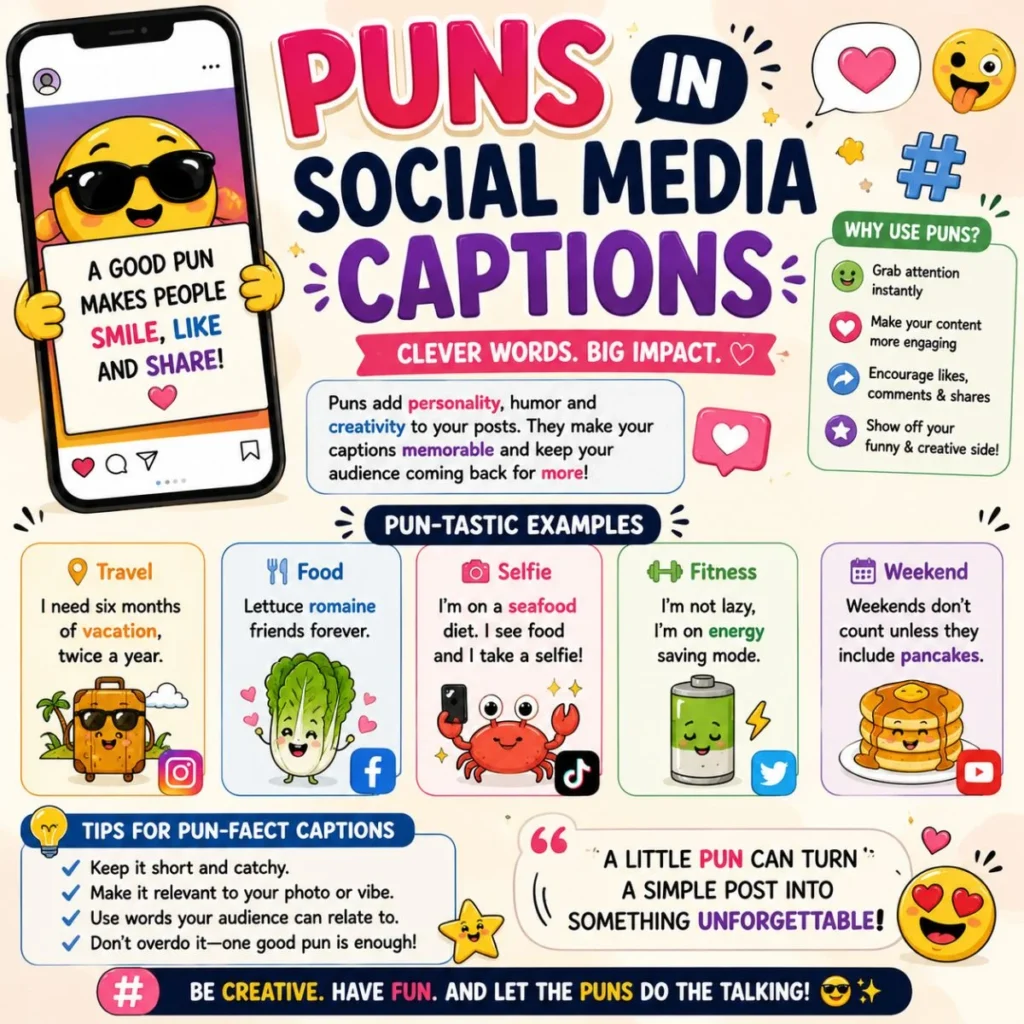
Puns have become incredibly popular on Instagram, TikTok, Facebook, and Pinterest because they’re short, memorable, and easy to pair with photos. A clever caption often earns more likes, comments, and shares than a plain sentence.
Whether you’re posting food, travel, pets, or selfies, a smart pun adds personality without trying too hard.
- “Just winging it. 🐔”
- “Donut worry, be happy. 🍩”
- “Orange you glad we’re friends?”
- “You’re one in a melon. 🍉”
- “Feeling grape today.”
- “Lettuce celebrate!”
- “Fries before guys. 🍟”
- “Life’s butter together.”
Clever Pun Examples That Show Off Your Wit 🧩
Some puns do more than earn a laugh—they make people admire your creativity. Clever puns often require a second to process, but that’s exactly what makes them satisfying. They’re ideal for trivia nights, friendly conversations, speeches, or anytime you want to add a little smart humor without overdoing it.
A good clever pun balances surprise and simplicity. If someone has to think for a moment before smiling, you’ve probably landed it perfectly. 😄
- “I used to be addicted to soap, but I’m clean now.”
- “The inventor of the knock-knock joke won the ‘no-bell’ prize.”
- “Broken pencils are pointless. ✏️”
- “A boiled egg every morning is hard to beat.”
- “The magician lost his job because he disappeared from work.”
- “I got a job at a mirror factory. I could really see myself there.”
- “The clock factory closed because everyone worked around the clock.”
- “The paper loved school because it always had good notes.”
- “The ladder wanted a promotion because it was ready for the next step.”
- “The blanket opened a business because it liked covering people.”
Puns Meaning in Literature and Famous Quotes 📚
Puns aren’t just for jokes—they’ve been used in literature for hundreds of years. Writers use them to add humor, emphasize a point, or make dialogue more memorable. Famous playwrights, novelists, and poets often included wordplay because it kept audiences entertained while adding extra layers of meaning.
Even today, books, movies, and television shows use puns to create memorable lines. Once you understand puns meaning, you’ll begin spotting clever wordplay in places you never noticed before.
- “The pen has a point, but so does the pencil.”
- “Every story has a plot twist—and sometimes a garden plot.”
- “The author had many chapters in life.”
- “The librarian always checked out.”
- “Words can carry more than one story.”
- “The poet couldn’t stop rhyming—it was verse nature.”
- “The editor made the write choice.”
- “The dictionary always has the last word.”
Food Puns That Never Get Stale 🍕😂
Food puns remain some of the most popular because everyone understands them. They’re perfect for birthday cards, restaurant signs, Instagram captions, and everyday jokes. Their playful nature makes them easy to remember and fun to share.
Whether you’re posting a coffee selfie or celebrating pizza night, these puns add extra flavor to your conversations. 😋
- “You’re the apple of my pie.”
- “Lettuce be friends.”
- “Olive you so much. 🫒❤️”
- “You’re bacon me wild.”
- “I cannoli think about you.”
- “You make miso happy.”
- “Life happens—eat dessert first.”
- “Donut ever change. 🍩”
- “You’re tea-riffic!”
- “This is nacho average joke.”
Animal Puns That Everyone Loves 🐶🐼
Animals naturally inspire playful wordplay because many species have names or sounds that fit perfectly into jokes. These puns are family-friendly, making them great for kids, classrooms, greeting cards, and pet lovers.
The funniest animal puns often mix personality with familiar animal traits, creating jokes that are both adorable and memorable.
- “Owl always love you. 🦉”
- “Have an otterly amazing day.”
- “You’re pawsome!”
- “Whale, hello there! 🐋”
- “Don’t be koi with me.”
- “Seal the deal.”
- “You’re purr-fect.”
- “I’m not lion when I say you’re awesome. 🦁”
- “Have a beary nice day.”
- “Stay pawsitive.”
Why Puns Are Great Icebreakers 💬
Starting a conversation can sometimes feel awkward, especially when you’re meeting new people. A lighthearted pun helps ease that tension because it invites laughter instead of pressure. Even if someone groans at the joke, it usually creates a shared moment that gets people talking.
That’s why puns are common at parties, networking events, classrooms, and online communities. They’re friendly, approachable, and rarely offensive when used appropriately. 😊
- “I tried to catch some fog, but I mist.”
- “I’m reading a map—it really shows me the way.”
- “The cookie visited the doctor because it felt crummy. 🍪”
- “The stadium got hot because it was full of fans.”
- “The pencil couldn’t stop drawing attention.”
- “I made a belt from watches—it was a waist of time.”
- “The light bulb had a bright idea. 💡”
- “The musician stayed positive because every note mattered.”
How to Create Your Own Puns ✨
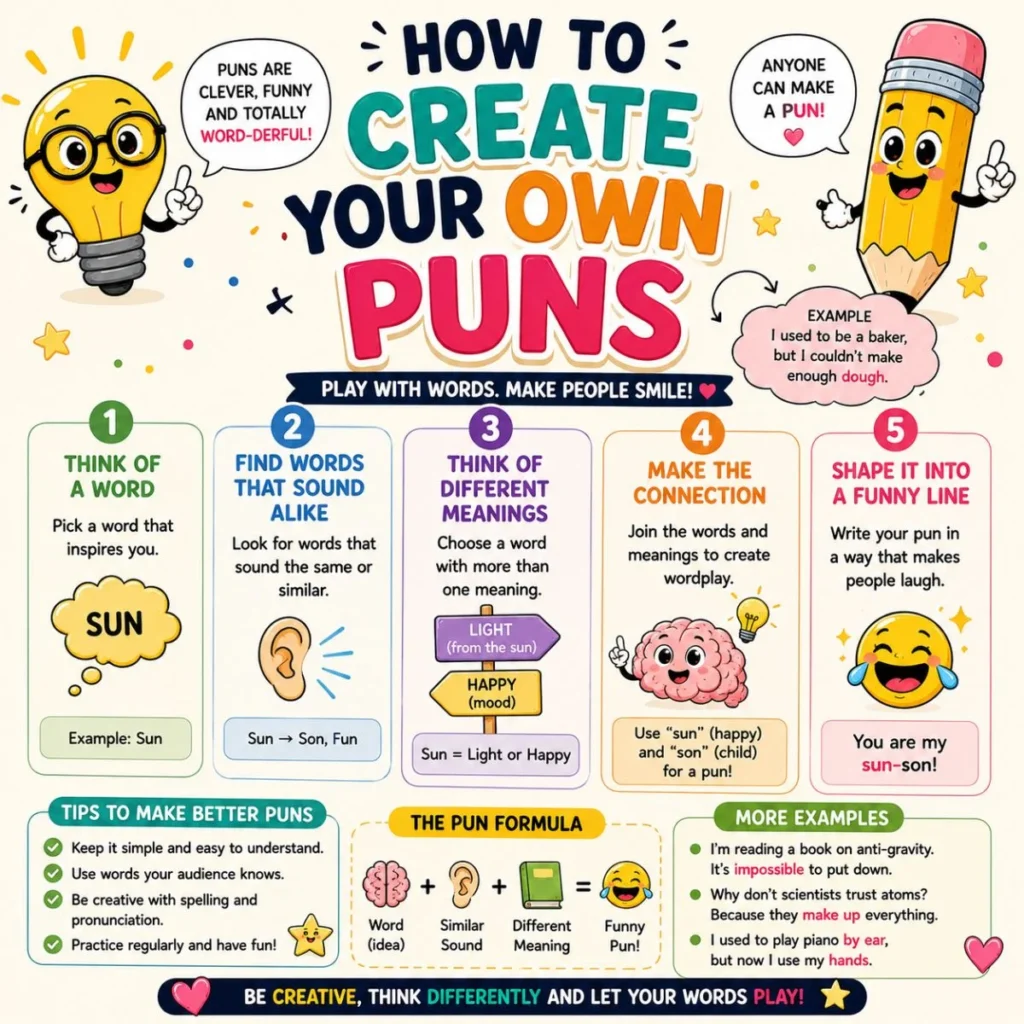
Learning puns meaning is only the beginning. Once you understand how wordplay works, you can start creating your own original puns. You don’t have to be a comedian or a professional writer. Most great puns come from paying attention to words that have two meanings or words that sound alike.
Start with a simple topic like food, animals, sports, or work. Then think of related words that could have another meaning. Experiment with different combinations until something feels unexpected and funny. The more you practice, the easier it becomes to spot opportunities for clever wordplay.
- Think about words with double meanings.
- Use homophones to create surprising twists.
- Keep your pun short and easy to understand.
- Don’t explain the joke—let people discover it.
- Test it on friends to see if it lands. 😄
- Mix common sayings with new ideas.
- Practice by rewriting everyday phrases.
- Have fun with it—creativity matters more than perfection.
Common Mistakes to Avoid When Using Puns 🚫
Puns are meant to entertain, but using too many at once can have the opposite effect. A clever pun works best when it appears naturally in the conversation rather than feeling forced.
It’s also worth considering your audience. Some people love witty wordplay, while others prefer straightforward humor. Reading the room helps you know when a pun will get laughs instead of confused looks.
- Don’t overuse puns in every sentence.
- Avoid jokes that require too much explanation.
- Keep the wording simple and natural.
- Match the humor to your audience.
- Don’t repeat the same style of pun.
- Use puns to enhance a conversation, not dominate it.
- Stay original instead of copying overused jokes.
- Remember that timing is just as important as the words. ⏰
Conclusion 🎉
Understanding puns meaning opens the door to one of the most enjoyable forms of language. A pun isn’t just a joke—it’s a clever way of using words to surprise, entertain, and connect with others. Whether it relies on similar sounds, double meanings, or unexpected twists, a good pun makes everyday conversations more memorable.
From social media captions and greeting cards to books and casual chats, puns continue to prove that language can be both smart and playful. 🌟 Once you start noticing them, you’ll see puns almost everywhere. Better yet, with a little practice, you’ll be creating your own wordplay that earns genuine laughs and plenty of smiles.
FAQs
1. What is the simple meaning of a pun? 😊
A pun is a joke that uses words with two meanings or words that sound alike to create humor. It’s a creative form of wordplay that’s both clever and entertaining.
2. Why are puns funny? 😂
Puns are funny because they surprise people with an unexpected meaning. Your brain first understands one interpretation before quickly realizing there’s another, which creates the humor.
3. What are some common examples of puns?
Popular examples include:
- “I used to be a banker, but I lost interest.”
- “I’m reading a book about anti-gravity. It’s impossible to put down.”
- “You’re one in a melon. 🍉”
4. Are puns and jokes the same thing?
Not exactly. A pun is a specific type of joke that depends on wordplay. Many jokes don’t use puns, while every pun is built around language and multiple meanings.
5. Where can I use puns?
You can use puns in conversations, greeting cards, speeches, classroom activities, social media captions, advertisements, presentations, and even business marketing when they fit the tone.
6. Are puns good for Instagram captions? 📱
Yes! Short, clever puns often make captions more engaging. They’re easy to remember, encourage interaction, and add personality to your posts.
7. Can children understand puns?
Many simple puns are perfect for children. As kids build their vocabulary, they begin to recognize wordplay and often enjoy creating their own funny puns.
8. How can I get better at making puns? ✨
Read more jokes, notice words with multiple meanings, practice combining similar-sounding words, and don’t be afraid to experiment. Creativity improves with practice.

Mason Reed is a humor writer at PickupPun, creating funny puns, clever pickup lines, and entertaining jokes for every occasion. He loves making people laugh with fresh, creative, and shareable content.