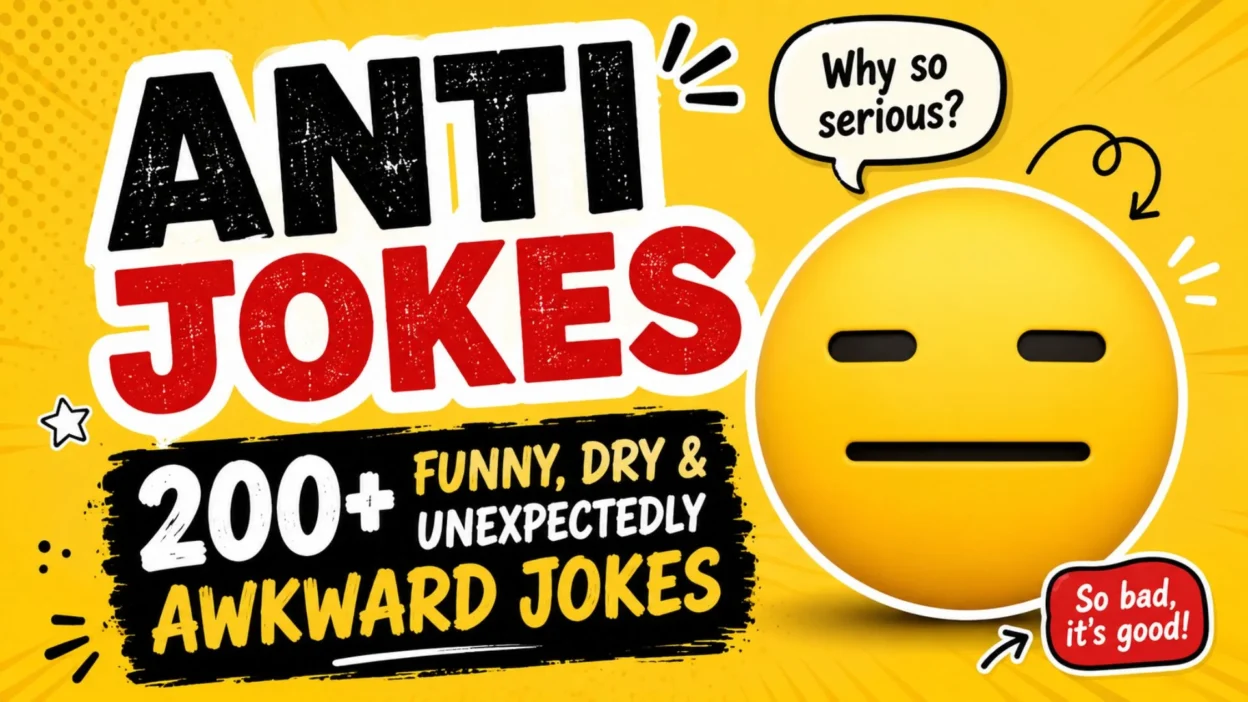
If you enjoy humor that makes you pause for a second and wonder, “Was that really the punchline?” then anti jokes are exactly your kind of comedy. 😆 Instead of ending with a clever twist, these jokes often deliver an obvious, literal, or completely ordinary answer. That lack of a traditional punchline becomes the joke.
Unlike regular jokes, anti jokes deliberately play with your expectations. You hear a familiar setup, prepare yourself for something hilarious, and then receive an answer that is almost painfully straightforward. As a result, the surprise comes from how little happens.
This collection brings together funny, clean, weird, clever, and wonderfully awkward anti jokes for different moods. You can share them with friends, drop them into group chats, use them as social media captions, or simply read through them when you want a different kind of laugh. 😂
Best Anti Jokes for a Perfectly Awkward Laugh 😐
The best anti jokes usually have one thing in common: they sound as though a clever punchline is coming. Instead, the ending stays completely literal. That contrast creates the humor, especially when you deliver the answer with a straight face.
These examples are great starting points because they are simple, clean, and easy to understand. So, if someone expects a traditional joke, give them one of these and enjoy the confused silence afterward. 😄
- Why did the chicken cross the road? — To get to the other side.
- Why did the man go to the store? — He needed something.
- What did the wall say to the other wall? — Nothing. Walls cannot talk.
- Why did the dog sit down? — It wanted to sit down.
- What happens when you drop a glass? — It breaks.
- Why did the woman open the door? — She wanted to go outside.
- What did the chair say to the table? — Nothing. Furniture does not speak.
- Why did the student open the book? — To read it.
- What did the clock say? — Nothing. It was a clock.
- Why did the person turn on the light? — It was dark.
- What did the tree say to the wind? — Nothing.
- Why did the man wear shoes? — His feet needed protection.
- What happens when ice gets warm? — It melts.
- Why did the bus stop? — It reached a bus stop.
- What did the pencil do? — It remained a pencil.
Funny Anti Jokes That Take Comedy Too Literally 😂
Literal humor is at the heart of many anti jokes. Instead of searching for a hidden meaning, these jokes simply answer the question exactly as it was asked. Therefore, the humor comes from taking ordinary language far too seriously.
This style works particularly well with friends who enjoy dry comedy. Moreover, these jokes are easy to remember, so you can use them whenever a conversation needs a deliberately terrible punchline.
- Why did the apple fall from the tree? — Gravity.
- Why did the balloon pop? — The balloon popped.
- Why did the phone ring? — Someone called.
- Why did the rain fall? — Rain falls.
- Why did the man sit in the chair? — He wanted to sit.
- What is orange and round? — An orange.
- Why did the light go off? — Someone turned it off.
- What did the book do after closing? — It stayed closed.
- Why did the cat enter the room? — It entered the room.
- Why did the person drink water? — They were thirsty. 💧
- What is cold and white? — Snow.
- Why did the door open? — Someone opened it.
- What did the clock do at noon? — It showed noon.
- Why did the dog bark? — The dog barked.
- What happened to the broken pencil? — It remained broken.
Short Anti Jokes for Quick Laughs ⚡
Sometimes, a joke becomes funnier when it ends almost immediately. Short anti jokes remove unnecessary details and leave you with a tiny setup followed by an intentionally boring answer.
Because they are so brief, these jokes work nicely in comments, captions, texts, and quick conversations. You can also use them when someone asks you to “tell a joke” and you want to give them something completely unexpected.
- What is a chair? — A chair.
- Why did he run? — He was running.
- What is green? — Something green.
- Why did she stop? — She stopped.
- What is water? — Water.
- Why did the man sleep? — He was tired.
- What is a shoe? — Something worn on a foot.
- Why did the bird fly? — It can fly.
- What is a sandwich? — Food.
- Why did the dog leave? — It left. 😆
- What is a tree? — A tree.
- Why did the light turn on? — Someone turned it on.
- What is a book? — A book.
- Why did the person sit? — They wanted to sit.
- What is a table? — A table.
Clever Anti Jokes With Dry Humor 🧠
Not every anti joke needs to be completely pointless. Some are clever because they answer a familiar question with cold logic. The joke works because the listener expects imagination, while the response chooses accuracy instead.
As a result, these jokes are ideal for people who enjoy deadpan humor and subtle comedy. Try reading them without changing your expression. The serious delivery makes the deliberately boring answer even better.
- Why was six afraid of seven? — It wasn’t. Numbers cannot feel fear.
- Why can’t a bicycle stand by itself? — Because it is a bicycle.
- Why did the scientist enter the lab? — To conduct an experiment.
- Why did the teacher enter the classroom? — To teach.
- Why did the chef go into the kitchen? — To cook.
- Why did the mechanic open the hood? — To inspect the engine.
- Why did the photographer take a picture? — He wanted a picture. 📸
- Why did the writer open the laptop? — To write.
- Why did the farmer enter the field? — To work.
- Why did the driver start the car? — To drive.
- Why did the artist pick up a brush? — To paint.
- Why did the musician pick up the guitar? — To play it.
- Why did the student study? — To learn.
- Why did the baker turn on the oven? — To bake.
- Why did the gardener water the plants? — They needed water.
Weird Anti Jokes That Make No Sense 🤨
Weird anti jokes take the basic concept and push it into strange territory. However, they still avoid the normal punchline. Instead, you get a response that is oddly specific, completely ordinary, or so literal that the setup suddenly feels unnecessary.
That awkward disconnect is what makes these jokes fun. In fact, the more seriously you treat the strange situation, the better the delivery can become.
- Why did the penguin enter the building? — The door was open.
- Why did the banana sit down? — It was there.
- What did the invisible man see? — Whatever was in front of him.
- Why did the robot take a nap? — It was tired.
- What did the mysterious box contain? — Something inside the box.
- Why did the alien visit Earth? — It came to Earth.
- Why did the dinosaur walk away? — It walked away.
- What did the ghost eat? — Food. 👻
- Why did the moon appear at night? — It was visible.
- Why did the spaceship land? — It landed.
- What did the monster do at breakfast? — It ate breakfast.
- Why did the turtle move slowly? — Turtles are slow.
- What did the magician pull from his hat? — His hand.
- Why did the dragon open the door? — It wanted the door open.
- What did the talking dog say? — Nothing. It wasn’t actually talking.
Clean Anti Jokes for Kids and Families 👨👩👧👦
Clean anti jokes are easy to share because they avoid complicated references and inappropriate humor. Instead, they rely on simple situations that children and adults can understand.
For family gatherings, classrooms, road trips, or casual conversations, these jokes provide harmless laughs. Plus, their simple structure makes them easy for kids to repeat. 🥳
- Why did the cow go outside? — It wanted to be outside.
- Why did the rabbit hop? — Rabbits hop.
- Why did the fish swim? — Fish swim.
- Why did the bird fly? — It was a bird.
- What does a cow drink? — Water.
- Why did the child eat lunch? — It was lunchtime.
- Why did the dog chase the ball? — It wanted the ball.
- What is a banana? — A fruit.
- Why did the horse run? — It decided to run.
- What did the turtle do? — It moved slowly.
- Why did the sheep stand in the field? — It was a sheep.
- What color is grass? — Usually green.
- Why did the boy wear a hat? — He put one on.
- What does a duck do? — It does duck things.
- Why did the child laugh? — Something made them laugh.
Anti Jokes for Text Messages 📱
Text messages are perfect for anti jokes because the reader cannot see your facial expression. Therefore, a completely serious setup can make the final answer feel even more ridiculous.
You can send these as random replies, use them in group chats, or surprise a friend who asks you for something funny. Keep the message short, though. The silence after the punchline is part of the experience.
- Why did I text you? — I wanted to send a text.
- Why did I reply quickly? — I had my phone nearby.
- What did my phone say? — Nothing. Phones do not talk.
- Why did my battery reach zero? — I used the battery.
- Why did I check my phone? — I wanted to check it.
- What happens when you delete a message? — It gets deleted.
- Why did the notification disappear? — I opened it.
- What did autocorrect do? — It corrected something. 📱
- Why did the charger stop working? — It stopped working.
- Why did I leave you on read? — I read the message.
- What happens when you send a message? — Someone may receive it.
- Why did my screen go dark? — The screen went dark.
- What did the emoji say? — Nothing. It was an emoji.
- Why did I turn on Wi-Fi? — I wanted internet access.
- What happens when the phone dies? — The phone turns off.
One-Liner Anti Jokes for Social Media ✨
One-liners make excellent captions because they need almost no context. A simple sentence can create the impression that something clever is coming, only to end with a painfully obvious statement.
Furthermore, these lines work well on Instagram, Facebook, TikTok captions, and casual status updates. Pair one with an unrelated photo, and the contrast can make it even funnier.
- I told a joke about paper. It was about paper.
- I opened a book. It had pages.
- I went outside. It was outside.
- I looked at the sky. It was still there.
- I drank water. It was wet.
- I bought a chair. Now I own a chair.
- I wore socks. They were socks.
- I saw a bird. It was a bird.
- I took a selfie. It showed my face. 📸
- I made a sandwich. Then I ate it.
- I checked the time. It was the time.
- I opened the fridge. Food was inside.
- I turned on the television. It turned on.
- I sat down. Then I was sitting.
- I went to bed. Then I was in bed.
Anti Jokes for Group Chats and Parties 🎉
Group chats often move quickly, so simple jokes have an advantage. Everyone can understand an anti joke within seconds. Then, the deliberately flat answer can create the exact kind of awkward reaction that makes people send laughing emojis.
At parties, delivery matters even more. Say the setup confidently, pause for a moment, and then give the most obvious answer possible. Do not explain it afterward. 😎
- Why did everyone come to the party? — There was a party.
- What did the DJ play? — Music.
- Why did the music stop? — Someone stopped it.
- What did the guests eat? — Food.
- Why did everyone clap? — They were clapping.
- What happened when the cake arrived? — The cake arrived.
- Why did someone take pictures? — They wanted pictures.
- What did the host do? — Hosted the party.
- Why did someone leave early? — They left early.
- What happened after the party? — People went home.
- Why did the lights turn on? — Someone switched them on.
- What did everyone talk about? — Various things.
- Why did someone laugh? — They found something funny. 😂
- What happened when the snacks finished? — There were no snacks left.
- Why did the music get louder? — Someone raised the volume.
Anti Jokes That Sound Like Real Questions 🤔
Some of the strongest anti jokes begin with a question that seems to demand an imaginative answer. Instead, the response simply states what anyone could have figured out.
This format works because your brain automatically searches for a hidden meaning. Then, the literal answer interrupts that process. Consequently, even an ordinary fact can feel funny.
- Why did the apple fall? — Gravity.
- Why did the door open? — Someone opened it.
- Why did the glass break? — It was broken.
- Why did the candle go out? — The flame went out.
- Why did the clock stop? — It stopped working.
- Why did the ice melt? — It got warmer.
- Why did the paper tear? — It was torn.
- Why did the water spill? — The container tipped over.
- Why did the chair move? — Someone moved it.
- Why did the alarm ring? — It reached its set time.
- Why did the computer shut down? — It was shut down.
- Why did the window close? — Someone closed it.
- Why did the ball roll? — It was pushed.
- Why did the plant grow? — It had the conditions to grow.
- Why did the light shine? — It was turned on.
Anti Jokes With the Worst Possible Punchlines 😭
Sometimes the funniest anti joke is the one that makes you regret asking for a joke in the first place. The setup promises something entertaining, but the ending delivers almost nothing.
That is precisely the point. These jokes work best when the punchline feels deliberately disappointing. So, tell them confidently and let your audience decide whether to laugh or simply stare at you.
- What do you call a funny joke? — A joke that is funny.
- Why did the man cross the street? — He crossed the street.
- What happened to the missing sock? — It was missing.
- Why did the pencil stop writing? — It had stopped writing.
- What did the empty box contain? — Nothing.
- Why did the person open the empty box? — They wanted to see inside.
- What did the broken clock show? — Whatever time it showed.
- Why did the dog lie down? — It lay down.
- What happened when the alarm went off? — It went off.
- Why did the person turn around? — They turned around.
- What happened when the door closed? — It was closed.
- Why did the man look outside? — He wanted to see outside.
- What did the mirror show? — A reflection.
- Why did the person pick up the phone? — They answered it. 😐
- What happened when nothing happened? — Nothing happened.
Funny Anti Jokes for Instagram Captions 📸
Instagram captions do not always need a dramatic punchline. Sometimes, a dry sentence can make a photo more memorable precisely because it refuses to explain anything.
Therefore, these anti jokes are useful for selfies, travel pictures, food posts, random snapshots, and everyday moments. Keep the caption short, and let the image provide the rest of the context.
- I took this picture because I had a camera.
- This is me standing somewhere.
- I went somewhere. This is proof.
- Here is a picture of food. 🍕
- I took a photo. This is the photo.
- This was taken outside.
- I was there when this happened.
- This is today’s picture.
- I looked at the camera.
- I posted this because I wanted to post it.
- Nothing special happened. I took a picture anyway.
- Here is a picture of me existing.
- This photo contains a person.
- I was holding a phone when I took this.
- This is what the camera saw.
Everyday Anti Jokes That Are Almost Too Normal ☕
The funniest anti jokes can come from everyday situations because the audience recognizes the setup immediately. Instead of adding an unexpected twist, the joke simply describes what happened.
For that reason, these examples are easy to adapt to your own experiences. Just take a normal event, frame it like a joke, and give the most straightforward answer possible.
- Why did I make coffee? — I wanted coffee.
- Why did I open the fridge? — I wanted food.
- Why did I put on a jacket? — I was cold.
- Why did I charge my phone? — The battery was low.
- Why did I set an alarm? — I needed to wake up.
- Why did I go to work? — It was a workday.
- Why did I sit on the sofa? — I wanted to sit.
- Why did I wash the dishes? — They were dirty.
- Why did I take a shower? — I needed a shower.
- Why did I close the window? — I wanted it closed.
- Why did I turn on the fan? — I wanted air movement.
- Why did I buy groceries? — I needed groceries.
- Why did I check the mailbox? — I wanted to check it.
- Why did I put food on a plate? — I wanted to eat it.
- Why did I go to sleep? — I was tired.
Anti Jokes With Unexpectedly Obvious Answers 😅
The final category brings together the kind of anti jokes that make you say, “Of course.” That reaction is exactly what makes them work. Instead of surprising you with a clever idea, they surprise you by refusing to surprise you.
Consequently, these jokes are perfect when you want dry humor that feels effortless. They are also easy to share because the setups require almost no explanation.
- Why did the sun come up? — It was morning.
- Why did the rain make the ground wet? — Rain is water.
- Why did the fire get hot? — Fire is hot.
- Why did the snow melt? — The temperature increased.
- Why did the dog need food? — It was hungry.
- Why did the person need sleep? — They were tired.
- Why did the plant need water? — Plants need water.
- Why did the car need fuel? — It uses fuel.
- Why did the computer need electricity? — It needs power.
- Why did the refrigerator keep food cold? — That is what refrigerators do.
- Why did the umbrella get wet? — It was raining.
- Why did the towel become wet? — It touched water.
- Why did the candle burn? — It had a flame.
- Why did the clock show a number? — It tells time.
- Why did the person laugh at an anti joke? — They found the anti joke funny. 😂
Conclusion
Anti jokes prove that comedy does not always need a brilliant punchline. Sometimes, the funniest response is simply the most obvious one. 😄 These jokes create a setup, build a tiny expectation, and then completely refuse to follow the usual rules of comedy.
From short one-liners and family-friendly humor to strange questions and painfully literal answers, anti jokes offer plenty of ways to make people laugh. The key is simple: keep the delivery serious, pause before the answer, and never explain why the joke is funny.
So, save your favorites, send one to a friend, or use a dry anti joke as your next caption. After all, sometimes saying exactly what happened is funny enough.
FAQs
What are anti jokes?
Anti jokes are jokes that deliberately avoid a traditional punchline. Instead, they usually end with a literal, obvious, ordinary, or unexpectedly serious answer. 😐
Why are anti jokes funny?
They are funny because they break the audience’s expectation. A normal joke leads you toward a punchline, while an anti joke leads you somewhere ordinary instead.
Are anti jokes the same as bad jokes?
Not quite. A bad joke may fail because it was poorly written. However, an anti joke is intentionally structured to avoid the normal punchline, so the lack of a clever ending becomes part of the humor.
Can kids enjoy anti jokes?
Yes. Clean anti jokes are usually simple and easy to understand. Family-friendly examples can work well at home, school events, parties, and road trips. 👨👩👧👦
How should I tell an anti joke?
Use a calm, serious delivery. Pause briefly before the answer, then say the literal punchline confidently. Avoid explaining it because the awkward reaction is part of the joke.
Can I use anti jokes as social media captions?
Yes. Short anti jokes work particularly well for Instagram, Facebook, TikTok, and other social platforms because they are easy to read and share. 📱
What makes a good anti joke?
A strong anti joke creates a familiar expectation and then answers it in an unusually literal or ordinary way. Good timing and a straight-faced delivery make the effect stronger.
Are anti jokes suitable for group chats?
Definitely. Their short format makes them easy to drop into conversations. They can be especially funny when everyone expects a clever punchline and receives a completely obvious answer instead. 😂

Mason Reed is a humor writer at PickupPun, creating funny puns, clever pickup lines, and entertaining jokes for every occasion. He loves making people laugh with fresh, creative, and shareable content.